
Asphalt Paving and Driveways
Compare quotes from local asphalt driveway companies
Asphalt paving and driveways are a popular choice for UK homeowners who want a hardwearing, practical and cost-effective surface. A well-laid asphalt driveway can give your home a clean, neat entrance and provide reliable off-road parking for many years.
If you are planning a new asphalt driveway, replacing an old surface or resurfacing an existing drive, we can help you compare quotes from local driveway specialists.
Fill in our quick quotation form and we’ll aim to connect you with up to 4 local companies that install asphalt and tarmac driveways in your area. You can then compare prices, advice and availability before choosing the right contractor for your home.
* Required fields.
We aim to help you take away the risk of hiring a rogue trader
What is an asphalt driveway?
An asphalt driveway is made from a mixture of aggregates, such as crushed stone, sand and gravel, bound together with bitumen. This creates a strong, flexible surface that can cope well with regular vehicle use.
Many UK homeowners use the word “tarmac” when they mean asphalt. Strictly speaking, they are not exactly the same. Modern asphalt uses bitumen as the binder, while traditional tarmac used tar. In everyday driveway quotes, however, many contractors and customers still use “tarmac driveway” and “asphalt driveway” to describe similar blacktop surfaces. Industry sources commonly describe asphalt as a mixture of aggregates and bitumen, while tarmac refers to aggregates bound with tar.
For homeowners, the most important question is not the name alone. It is whether the contractor installs the correct surface for the job, prepares the base properly and designs the driveway so it drains safely.
Are you a driveway specialist?
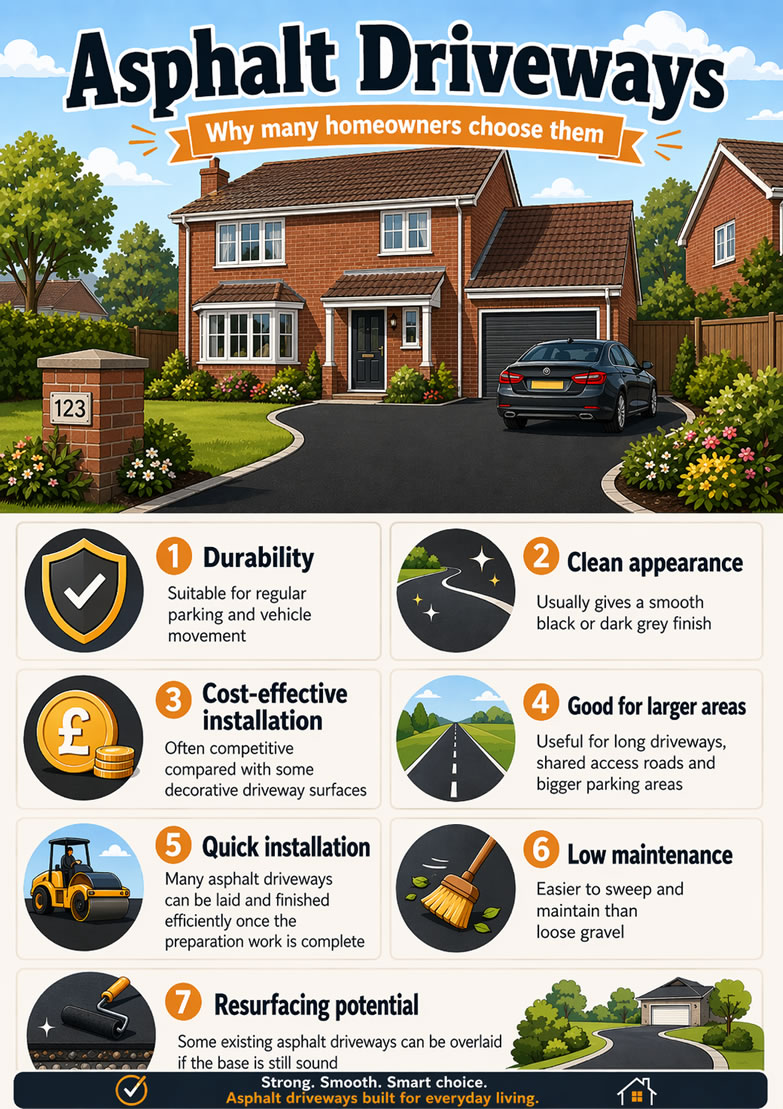
Why choose asphalt paving for your driveway?
Asphalt is widely used for roads, car parks and domestic driveways because it offers a strong and practical finish. It is especially suitable for homeowners who want a driveway that looks tidy, handles regular vehicle traffic and does not need the decorative detailing of block paving or resin.
Main benefits include:
- Durability — suitable for regular parking and vehicle movement
- Clean appearance — usually gives a smooth black or dark grey finish
- Cost-effective installation — often competitive compared with some decorative driveway surfaces
- Good for larger areas — useful for long driveways, shared access roads and bigger parking areas
- Quick installation — many asphalt driveways can be laid and finished efficiently once the preparation work is complete
- Low maintenance — easier to sweep and maintain than loose gravel
- Resurfacing potential — some existing asphalt driveways can be overlaid if the base is still sound
A properly installed asphalt driveway should not just look good on the day it is laid. It should have a suitable sub-base, correct falls, firm edges and a drainage plan.
Asphalt driveway vs tarmac driveway
For most homeowners, asphalt and tarmac are often treated as the same type of driveway surface. Contractors may describe the job as tarmac, asphalt, blacktop or bitmac depending on their terminology and the materials they use.
However, there are a few useful differences to understand.
| Feature | Asphalt driveway | Traditional tarmac driveway |
|---|---|---|
| Binder | Usually bitumen | Traditionally tar-based |
| Common modern use | Roads, car parks, driveways and resurfacing | Term often used generally for blacktop driveways |
| Finish | Smooth, dark and practical | Similar appearance in everyday domestic use |
| Durability | Strong when laid on a good base | Depends on material and installation |
| Homeowner takeaway | Ask what material and specification will actually be used | Do not rely on the name alone |
In practice, your quotation should clearly explain the surface, base preparation, depth, edging and drainage. That matters more than whether the contractor casually calls it tarmac or asphalt.
How much does an asphalt driveway cost?
The cost of asphalt paving and driveways varies depending on the size of the area, the condition of the existing ground, access, drainage, waste removal and the specification used.
Recent UK cost guides place asphalt driveway installation at roughly £45 to £112 per square metre, depending on the guide, specification and whether groundwork is included. One 2026 guide gives a broad range of around £45–£100 per m² including materials, labour and initial groundwork, while another places standard asphalt driveways around £80–£112 per m².
As a simple guide:
| Asphalt driveway work | Typical UK price guide |
|---|---|
| New asphalt driveway | Around £45–£112 per m² |
| Asphalt driveway resurfacing | Around £20–£30 per m² |
| Waste removal or grab lorry costs | Often extra, depending on excavation |
| Drainage channels or soakaway work | Extra, depending on site layout |
| Edging, kerbs and decorative borders | Extra, depending on design |
These figures are only a guide. A small driveway may cost more per square metre than a larger one because the contractor still has setup, labour, delivery and machinery costs. Likewise, a driveway needing deep excavation, new drainage or retaining edges will cost more than a simple resurfacing job.
What affects the cost of an asphalt driveway?
The price of asphalt paving can change significantly from one property to another. Before comparing quotes, it helps to understand what contractors are pricing for.
Size of the driveway
Larger driveways usually cost more overall, but the price per square metre may become better value once machinery, delivery and labour are already on site.
Existing surface
Removing old concrete, broken paving, failed tarmac or deep gravel can add time and disposal costs. If the existing base is unstable, the contractor may need to excavate deeper.
Ground preparation
Good preparation is one of the most important parts of the job. A weak sub-base can lead to sinking, cracking and potholes. Many driveway failures happen because the surface looks finished but the foundation underneath is poor.
Drainage
Driveways must manage rainwater properly. This could involve falls towards a permeable area, drainage channels, soakaways or a permeable asphalt system.
Access
If machinery, skips or delivery vehicles cannot access the site easily, labour costs may increase.
Edging and kerbs
Asphalt needs secure edges. Without proper edge restraint, the surface can crumble or break away at the sides.
Location
Labour rates and material costs vary across the UK. Prices may be higher in London, the South East and areas where access or parking makes the job harder.
Asphalt driveway resurfacing
If your existing asphalt or tarmac driveway is tired but still structurally sound, resurfacing may be possible. This usually means cleaning and preparing the old surface, repairing damaged areas and laying a fresh layer on top.
Resurfacing can be cheaper than a full replacement because the contractor may not need to excavate the entire driveway. UK cost guidance suggests asphalt driveway resurfacing can be around £20–£30 per m², although the final cost depends on the condition of the existing surface.
Resurfacing may be suitable if:
- The base is still stable
- There are no major drainage problems
- Cracks or worn patches are limited
- The existing levels still work
- The driveway does not need widening or redesigning
However, resurfacing is not always the best answer. If the driveway has deep cracks, potholes, movement, poor drainage or a failing base, a full replacement may give better long-term value.
Do asphalt driveways need planning permission?
Planning rules are an important part of driveway installation, especially when paving a front garden.
In England, you normally do not need planning permission if the new or replacement driveway uses a permeable surface, such as porous asphalt, or if rainwater is directed to a lawn, border or other permeable area within your property. However, if the area is more than 5 square metres and you use a traditional impermeable surface without providing drainage to a permeable area, planning permission may be required.
This is why drainage should be discussed at the quote stage. Your installer may recommend:
- Porous asphalt
- Drainage channels
- A soakaway
- A fall towards a garden or border
- Permeable paving sections
- A combined driveway and soft landscaping design
Different rules can apply to listed buildings, conservation areas, flats, shared access, new entrances and properties with local restrictions. You may also need separate permission from the local highways authority if you need a new dropped kerb or want to widen an existing one.
Porous asphalt and driveway drainage
Porous asphalt is designed to let water pass through the surface into a suitable sub-base below. This can help reduce surface water runoff and may support compliance with front garden paving rules.
However, porous asphalt only works properly if the whole system is designed correctly. The surface, sub-base and drainage layer all need to be suitable. If a contractor simply lays asphalt over an unsuitable base, it may not provide the drainage benefits you expect.
Ask your contractor:
- Is the proposed asphalt permeable or impermeable?
- Where will rainwater go?
- Will water run onto the pavement or road?
- Is a soakaway needed?
- Will drainage channels be installed?
- Are the levels correct near the house?
- Will the driveway comply with local planning guidance?
Good drainage helps protect your home, your driveway and the public drainage system.
How long does an asphalt driveway last?
A well-installed asphalt driveway can last for many years. The exact lifespan depends on the quality of installation, drainage, traffic levels, weather exposure and maintenance.
The most important factors are:
- A strong sub-base
- Correct compaction
- Good edge restraint
- Sensible drainage
- Suitable surface thickness
- Regular cleaning and basic maintenance
If the base is weak or water sits on the surface, problems can appear much sooner. Common signs of failure include cracks, potholes, crumbling edges and dips where vehicles park.
Pros and cons of asphalt paving and driveways
| Pros | Cons |
|---|---|
| Practical and hardwearing | Less decorative than block paving or resin |
| Good for cars and everyday use | Needs proper edging to stop crumbling |
| Often cost-effective for larger areas | Can soften slightly in extreme heat |
| Smooth and easy to clean | Poor installation can lead to cracks and potholes |
| Can sometimes be resurfaced | Drainage needs careful planning |
| Suitable for long drives and shared access | Colour options are more limited than some alternatives |
Asphalt driveway colours and finishes
Most asphalt driveways are black or dark grey. This gives a clean, simple look and works well with many UK homes.
Coloured asphalt may also be available in some areas, including red, brown or green tones. However, it can cost more and may not be offered by every contractor. Colour can also fade over time, especially in high-traffic areas.
If appearance is your main priority, you may also want to compare asphalt with:
- Block paving
- Resin-bound gravel
- Decorative concrete
- Gravel with stabilisation grids
- Mixed surfaces with block paved borders
Some homeowners choose asphalt for the main parking area and add block paving or kerbs around the edge for a smarter finish.
Asphalt driveway maintenance
Asphalt driveways are fairly low maintenance, but they still benefit from regular care.
To keep your driveway in better condition:
- Sweep away leaves and debris
- Remove moss and algae before the surface becomes slippery
- Avoid leaving heavy skips or machinery on unsupported areas
- Clean oil spills quickly
- Keep drainage channels clear
- Repair cracks before water gets underneath
- Watch for crumbling edges
- Avoid pressure washing too aggressively
Small cracks can let water into the driveway structure. Over time, freezing, thawing and vehicle pressure can make the damage worse. Early repair is usually cheaper than waiting until resurfacing or replacement becomes necessary.
Choosing an asphalt driveway contractor
The quality of your driveway depends heavily on the contractor you choose. Asphalt paving may look simple, but the preparation and drainage work underneath are vital.
Before hiring a company, ask:
- How long have you installed asphalt driveways?
- Can I see photos of similar work?
- What depth of excavation is included?
- What sub-base will be used?
- How will the surface be edged?
- How will rainwater drain?
- Is the quote for asphalt, tarmac, bitmac or another material?
- Is waste removal included?
- Is VAT included?
- Do you have public liability insurance?
- Do you offer a written guarantee?
A reliable contractor should be willing to explain the specification in plain English.
Compare asphalt driveway quotes
Asphalt paving and driveways can be a practical choice for many UK homes, but prices and specifications vary. Comparing quotes helps you understand what each contractor includes and whether the job has been properly planned.
When you use our quote form, we aim to connect you with up to 4 local asphalt driveway specialists. You can compare their advice, ask questions and choose the company that best suits your property and budget.
Get asphalt paving and driveway quotes today
Whether you need a new driveway, driveway resurfacing, a replacement tarmac surface or advice about drainage, local specialists can help you plan the job properly.
Complete the form today and compare free quotes from asphalt driveway companies in your area.
Get free asphalt driveway quotes now.
FAQs
Is asphalt the same as tarmac?
Not exactly. Asphalt usually uses bitumen as the binder, while traditional tarmac used tar. In everyday UK driveway language, many people still use “tarmac” and “asphalt” to mean a similar blacktop driveway surface. The key point is to ask your contractor what material and specification they will actually install.
Is asphalt good for driveways?
Yes, asphalt can be a good driveway surface. It is hardwearing, practical and suitable for regular vehicle use when installed on a strong base with proper drainage.
How much does an asphalt driveway cost in the UK?
A new asphalt driveway can cost roughly £45–£112 per square metre, depending on the size, groundwork, drainage, access and specification. Resurfacing an existing asphalt driveway can be cheaper if the base is still sound.
Can an asphalt driveway be resurfaced?
Yes, resurfacing may be possible if the existing driveway is structurally sound. If the base has failed, the driveway has major cracks or drainage is poor, a full replacement may be better.
Do I need planning permission for an asphalt driveway?
You may need planning permission if you are paving more than 5 square metres of front garden with an impermeable surface and rainwater does not drain to a permeable area within your property. Permeable surfaces, porous asphalt or drainage to a lawn, border or soakaway can often avoid the need for planning permission, but you should check local guidance.
How long does an asphalt driveway last?
A well-installed asphalt driveway can last for many years. Lifespan depends on the sub-base, drainage, surface thickness, vehicle use and maintenance.
Can asphalt driveways be coloured?
Yes, coloured asphalt may be available, although black and dark grey are the most common choices. Coloured finishes may cost more and can fade over time.
Is asphalt cheaper than block paving?
Asphalt is often cost-effective, especially for larger driveways. Block paving can cost more but gives a more decorative finish and allows individual blocks to be replaced. The best option depends on your budget, property style and maintenance expectations.